Showing posts with label Realistic Fiction. Show all posts

Jan 17, 2014

Review: A Mango-Shaped Space

A Mango-Shaped Space, by Wendy Mass, is a title that I have consistently recommended to students but, as of December 2013, had never read myself.  I knew that it was realistic fiction about a girl who saw letters and numbers in color (synesthesia), that the novel made many people cry, and that there was a cat named Mango (three guesses as to why everyone cries; hint: my theory about books with dogs on the cover).


After recommending it so many times and consistently getting positive feedback from the readers, I decided it was time to actually read it myself. I loved it.

At the start of the novel, Mia reflects on a traumatizing third grade experience when she tried to explain the proper colors for each number to her math class.  Ridiculed by her teacher and classmates when they did not follow along, Mia was forced to keep her visions a secret. But when she starts algebra, the combination of numbers and letters makes her secret too much to bear. Mia learns that her condition has a name, synesthesia, and dives into a world of information.  Mia must balance her new appreciation of her colorful life with her classwork, friends, family, and her cat Mango, whom she believes contains a piece of her grandfather's soul, a man who had always understood her in more ways than she could have known. 

I really welcome stories that offer new perspectives.  You can never really see what another person sees, especially in Mia's case. What I enjoyed most about this novel was the emphasis on trust.  Mia experiences so much disbelief from others: her teachers, classmates, parents, even her best friend, that it's heartwarming to see her remain so trusting as she works to educate both herself and others about her condition. It's also important for the child and young adult readers to experience the distrust and teasing that Mia encounters in her quest for the truth.

I think the only aspect of the novel that bothered me was the fact that she never got caught for falsely going to acupuncture to heighten her synesthesia. If you've read it, did that bother you?

Oct 11, 2013

#TheList, No. 1001: Finding Violet Park

Through a strange turn of events, teenager Lucas Swain gains possession of an abandoned urn containing the ashes of a Violet Park. While researching Violet, Lucas unknowingly begins to call up his father's mysterious past. Lucas' father disappeared five years ago.  No one knows where or why he ran away, or if he ran away at all. Lucas is frozen in time, clutching onto his father's belongings because he doesn't have the memories to sustain him.  His research, however, finally allows Lucas an out, as he learns that "dead" doesn't just have to be a physical condition.  


Finding Violet Park, by Jenny Valentine, was originally published in London. It was later republished in America as Me, the Missing, and the Dead, which is the title I picked up and, after finishing the book, that I prefer. I don't know if I would have picked up this book if it weren't on The List, but I'm glad I read it. I enjoyed the various perspectives of the missing and the dead. Dead doesn't have to mean "dead" if that person's memory and life remain with you. On the other hand, missing can can equate with dead - Lucas' father is gone and no longer a worthy part of his life. Lucas' actions at the close of the book confirm his feelings on this matter. The newer title creates three categories that, throughout the course of the novel, Lucas realizes can all be intertwined depending on his actions. For five years, he's been missing his life, instead clinging on to what is no longer present. Finding Violet Park is just a small piece of the puzzle that leads him to eventual catharsis. 

The novel contains dark humor (for instance, Lucas provides a list of good reasons to make friends with a dead lady in an urn), realistic portrayals of family and extended family, and an interesting mystery to carry forth the discussion of what it means to be dead or missing.  It'd be an interesting choice to include in a Halloween display as it's spooky in a nontraditional sense.  

Aug 28, 2013

Before I Fall

Samantha Kingston dies in a car crash...then she wakes up in the morning and relives her last day on earth. It happens again and again without reason. Even changing her behavior and patterns doesn't prevent her from reliving "Cupid Day," the Friday before Valentine's Day where students send roses to one another as a sign of popularity (think "Four for you Glen Coco, you go Glen Coco!"). Reliving Cupid Day shines a new light on Samantha's outlook on her friends, her less than affectionate boyfriend, her family, and the outcasts she looks down on. She's quite literally forced to face herself and make changes before she can move on, whether or not it's in life or death.


Lauren Oliver's Before I Fall is pretty popular with the teens at my school.  I can see why. The cover is attractive, and it has an interesting premise, good lessons, and high school drama from varying angles that any tween/teen can connect with.  Originally I felt that it wasn't the best written book - as the day repeats, characters seemingly change motivations - but when I realized this was happening as a reflection of Samantha's maturing, I had a lot more respect for the work. It still feels clumsy here and there, but for teens looking for a realistic plot about self discovery and life lessons, it's a respectable choice.

And yes, it is a less funny Groundhog's Day in YA novel form.

Because I mentioned it above: 

Jun 13, 2013

Me and Earl and the Dying Girl

Me and Earl and the Dying Girl is Greg's, a high school senior, account of his time spent with Rachel, a girl recently diagnosed with leukemia.  But no, it's not that kind of Nicholas Sparks novel. There's no wedding to live out a dying girl's last wish, no life-changing lessons learned, no dramatic court scene to get her the treatment she needs.  Greg tells the reader of this right off the bat.  Alternating between lists, scripts, and prose, Greg explains how he was forced by his Mom to befriend the dying girl, how he is a failure at cheering up the soon-to-die, and how he realized he was the worst filmmaker of all time.

This novel is for the older teen with the twisted sense of humor - aka my favorite patron. This novel is all kinds of dark. It also contains a LOT of crude language, some violence, discussion of death, and various references to drug use, including one hilarious scene where Greg, who doesn't do drugs, is accidentally high and is afraid that the silence in the room is "possible racist silence."

The sheer ridiculousness, but also insightfulness (I made up a word) of the accidental high scene caused me to erupt into laughter while on an un-airconditioned subway stuffed full of miserable people trudging to their jobs who were unappreciative of my glee. 

Anyway, this novel is darkly hilarious, a little depressing here and there (the words "dying girl" are in the title, after all), and a great reminder of how we need to take a break from putting ourselves first all the time.  It's Jesse Andrews' debut novel and I'm excited to see what he does next. 

Jun 9, 2013

Gone, Gone, Gone


Gone, Gone, Gone takes place about a year following the 9/11 terrorist attacks, when the DC-area sniper was at large.  The novel captures the heightened fear that the sniper brought to the nation. It also comments on the way we often try to take ownership of the tragedies that happen to our communities and the nation as a whole.

The novel utilizes dual narration, with alternating chapters of Lio and Craig's perspective on the terror and its impact on their burgeoning relationship.  Craig is an ultra-sensitive teen, still reeling from the loss of his first love, and Lio is a cancer survivor from NY who is new to the DC area. The two have an immediate connection with each other, and work toward a relationship all the while working through their feelings on who can claim ownership of the tragedies, who is allowed to feel scared, why they personally shouldn't feel scared, etc.

It can get pretty angsty and at times, confusing, but the teen's dramatic interactions ring true.  They are informed by the author's (Hanna Moskowitz) own experiences during the sniper attacks and I think that many readers who have experienced a tragic national event will understand the emotions Lio and Craig experience. I personally won't forget how freaked out I was by the DC sniper and I was all the way in Boston when that happened. [Seriously, I once had a nightmare that I was a victim. I woke up the next day to news that there was, in fact, another victim. My father then walked past me in the hallway when I said good morning and I was convinced for about 5 minutes that I was a ghost.] Fast forward to the Boston Marathon 2 months ago and while I was terrified, I wanted nothing more than to go about my normal routine and prove that I was strong (Boston Strong, if you will).

What I liked best about the novel was that all of the conflicts were related to the national tragedies and not LGBT matters.  There are no negative consequences - broken hearts aside - from the main characters' homosexuality.  It's just a normal thing.

Jun 8, 2013

Putting Makeup on the Fat Boy

Putting Makeup on the Fat Boy, by Bill Wright, is featured as a popular paperback in the 2013 Hub Reading Challenge.  Carlos is a gay teenager dead-set on getting a makeup sales job at Macy's.  Along with working toward his loft goal, Carlos grapples with his sister's homophobic and abusive boyfriend, his mother's unemployment, his crush on a straight boy, his best friend's image issues, and his chance to help a TV star with sensitive skin.  It's a lot for a teen to handle. 

I would classify this novel as realistic fiction for it's portrayal of homophobia and bullying, as well as the concentration on familial relationships.  But the realism definitely takes a backseat when Carlos is at work, particularly when working for a celebrity.  And that's fine, because it incorporates some fun alongside difficult topics.  The book is funny, emotional and overly ridiculous at times, but I can understand why teens would find the often self-absorbed Carlos an empathetic and entertaining character.  It's a great touch that Carlos acknowledges throughout the novel that he is self-absorbed, but then just keeps on being himself.  He's a great son, brother and friend. He knows he doesn't have to change; he knows he's fabulous.  Without the acknowledgment, he might be a little more tough to take. 


That being said, I'll be honest, I wasn't a big fan of this selection.  While certainly funny with a few poignant moments of self-realization, family and friendship, ultimately the novel lacked some sort of oomph. Perhaps, Wright bit off more plot than he could chew. The novel ends without closure for basically every story element.  While it's not an unusual tactic for an author to take, in this particular novel, it felt a little lazy.

There is mention of domestic abuse and one scene of physical bullying. Outside of these instances, the novel is fairly mild in language and plot, so I would definitely recommend this to mature middle-schoolers through 10th graders.

Jun 5, 2013

The White Bicycle

I just found out that this Printz Honor book is actually the third in the Wild Orchard series. So right off the bat, I can tell you that you don't need prior knowledge of the first two in order to fall in love with this novel.


19-year-old Taylor has Asperger's Syndrome, and is traveling to France with her mother in order to work as a "personal care assistant" to boost her resume in her continued attempts at achieving total responsibility.  While making decisions and learning about the world around her, Taylor grapples with her mother's constant life interference and inability to let her be a woman. The ultimate reveal of  betrayal is both heartbreaking and uplifting as Taylor keeps on keeping on toward her personal goals.  I'm definitely going back and reading the other novels in the series when I get a chance.

I've encountered many young adults who love the novel The Curious Incident of the Dog in the Night-Time as well as Marcelo in the Real World, both of which focus on a main character with Asperger's.  In the past, they have asked me for more books with similar plots and themes, and I'm definitely adding The White Bicycle to my mental list.  Brenna paints a realistic depiction of Taylor's thoughts and confused emotions throughout her experiences.  I believe teens will relate to Taylor's conflicts with family and life; the way she describes her understanding of events and emotions are peculiar yet insightful and even without the perspective of a person living with Asperger's, they apply to the angst and emotional rollercoasters that can be a teenager's life.

Jun 3, 2013

The Running Dream

If you have someone looking for a happy ending book about someone going above and beyond overcoming adversity, The Running Dream, by Wendelin Van Draanen, is what you need to reach for.
 

Jessica wakes up in the hospital after a severe car accident.  Her leg has been amputated.  Her days of track team and running seem over. She struggles with adjusting to her new life: simple tasks are difficult, she's behind in school, track is no more, insurance woes plague her family; she just can't seem to put one foot in front of the other (don't groan, the book is chock full of puns like this!).  But slowly and surely Jessica adapts to the changes in her life and takes on new challenges as she learns what is truly important in this world.

My only major issue with the book is something that only happens in a brief section: Oscar Pistorious named as a role model for Jessica.  While other famous disabled runners are also mentioned, he comes first and, with 2 missing legs, understandably has a bigger impact on Jessica.  However, due to recent events, people have shifted on their feelings about him and that recent history pulls at the reader quite a bit when his name comes into play.  Obviously, this happened after the book's release, but it's akin to reading a story about someone being inspired by OJ Simpson.  So much yikes.

Also, the constant stream of successes for Jessica as she works toward her happy ending might bother some readers for being unrealistic.  The way she soars through recovery sometimes makes it seem like her bigger challenge is her crush on a boy, not her missing leg.  But it didn't bother me, because I liked feeling uplifted by the character's successes, particularly her new friendship with a fellow classmate with cerebral palsy.

I'm not a runner, but being from Boston, this book really resonated with me.  The cynic in me could say that this novel is overly optimistic at times, especially with how fast Jessica makes her recoveries and easily (as easy as it can be with one leg) overcomes every obstacle she faces, but the stories of hope that keep coming from the Boston Marathon bombing victims erase my cynicism and make me appreciate the hopefulness of the story.


I think The Running Dream could work in so many displays: sports, marathons, health, quick picks, etc.  It is a fast, interesting read that incorporates overcoming adversity with typical teenage obstacles that young adult readers will appreciate reading, with or without an interest in track.  

Feb 22, 2013

Throwback: The Great Gilly Hopkins

I found The Great Gilly Hopkins amongst my pile of books I own but have yet to read.  It's shiny Newbery Honor gleamed up at me, guilting me into finally reading it.  I'm glad I did.


Gilly's the stereotypical "I don't care about anyone but myself" foster child, moved from house to house and just wanting to go back to her mother in California because she's convinced herself that her mother wants her back.  Spoiler alert, she doesn't.  Gilly is brought to Ms. Trotter, a woman who makes it her mission to right the lives of poor foster children.  Yes, it seems like it's setting itself up to be a modern Little Orphan Annie, but then Katherine Paterson jerks the rug out from beneath you.

First, Gilly doesn't go through the formulaic routine of acting like a brat, encountering a magical moment where someone believes in her, and then becoming an angelic figure.  She still acts like a rotten brat, but Paterson fleshes out her leading lady. Despite maintaining her tough exterior, Gilly internalizes the expectations she assumes others have of her and does the opposite. Simple example: Trotter doesn't tell her to brush her hair and Gilly interprets this as Trotter thinking Gilly incapable of looking presentable.  To combat this, Gilly brushes her hair and goes to school to show that she can be presentable.  This pattern occurs throughout the novel, turning Gilly into more than a grouchy foster child despite her every intention to remain one.

Secondly, and spoiler alert, there's no happy ending. Gilly doesn't have a happy reunion with her mother, nor does she get to stay with Trotter and the makeshift family she could finally define as home.  Gilly is forced to live with her grandmother (due to Gilly's previous actions) and despite her vociferous protesting, she can't beat the system.  Despite this unhappy ending, Trotter reassures Gilly, and by proxy, the reader, that it's just how life works.  There are ups and downs, but you have to make the most of everything.

Apparently, a movie is in the works with Kathy Bates and Danny Glover, presumably playing the parts of Trotter and Mr. Randolph (the blind neighbor) respectively.


Jul 26, 2012

#TheList, No. 987: The Running Man

First things first.  This book was not what was advertised.  Don't call something a "thriller" unless it's a thriller.  It's one of my biggest pet peeves. Like the re-issued classics that have Twilight styled covers.  One of those fans who now wants to rip Kristen Stewart's heart out will be hypnotized by the cover, go home expecting a sheriff father observing an abusive relationship that is deemed perfectly acceptable, and be saddened when that's not s/he they gets.

Other than that misleading bit of information, Michael Gerard Bauer's The Running Man was a fairly competent young adult novel. 

The premise: A young teen, Joseph, needs to complete a portrait for an art class and ends up using his recluse neighbor, Tom, as a subject.  Tom is the focus of much gossip spread by the token nosy neighbor, Mrs. Mossop (rhyming!), causing Joseph to feel hesitant about undertaking such a project.  But while working, he comes to know Tom better, and learns why he's become the recluse he is today.  He also helps him take care of silkworms...it's part of a whole symbolism thing.

The story is a typical "kid reaches the age where he learns that adults have problems too." To quote the first episode of Friends: "Welcome to the real world! It sucks. You're gonna love it."  What sets The Running Man apart from similar stories, is that Tom isn't the only adult shown to have problems.  The titular figure, the "running man," a seemingly psychotic man who runs raggedly around the town and the subject of many of Joseph's nightmares, also has deeply rooted problems that impact his behavior.    Even Joseph shows signs of experiencing some of these "grown-up" problems as the novel progresses toward the revelation of Tom's terrors. 

The silkworm symbolism was a little heavy, but for young readers, it'll help them understand the novel's happenings. 

Who would I give this too: Not someone expecting a thriller, that's for sure.  I still don't see how that reviewer could see "thriller." Maybe an emotional thrill? Anyway, I would give this to someone who likes realistic fiction and serious subject matters. 

Also, this novel has nothing to do with the popular dance move of the same name.  I know, I was sad too. 

Jul 9, 2012

#TheList, No. 849: Grover

Grover seems like a simple book.  A boy living off somewhere in the country, he helps his veterinarian uncle from time to time, he goes fishing with his friends, he makes up stories to entertain them during their adventures, and he enjoys the simple things in life.  So why is it so special that ti's included on The List (not that special is a qualification...again, Twilight is on there)? It's a book that examines different reactions to death.

Yeah, spoiler alert, the Mom dies.  But it's not really a spoiler because it's in the back cover description. 

Anywho, what happens when you don't feel a terrible sorrow that someone has passed?  What happens when grief seems to hold onto your life and dictate your every move?  Both of these reactions to a loved one's death are presented in the novel, and it's a bit reassuring to a reader that either reaction is acceptable or normal. 

Would I recommend giving this to someone who just experienced a loss? Ehhhh no? Maybe?  It's a little dated, and some of the sparsely used (thankfully) illustrations are downright frightening, and for a novel that discusses death, it sometimes feels like it's pushed into the background.  Yes, I get it, it's because life goes on.  But a kid might not want to read something that addresses a recent loss so nonchalantly through the title character.  I think that this book is more for the reflective type of person.  Maybe someone who experienced a loss, but not recently.  But, like everything, it depends on the person.
Unfortunately, this Grover isn't the main character
Apparently this children's/YA novel is part of three part book series that deals with the same characters.  It obviously doesn't have to be read in order...or else I'm just a rebel.  But no, important character details that came into play in previous books are reiterated in conversations and exposition, so really, it's not necessary to be familiar with the story beforehand. 

Jun 20, 2012

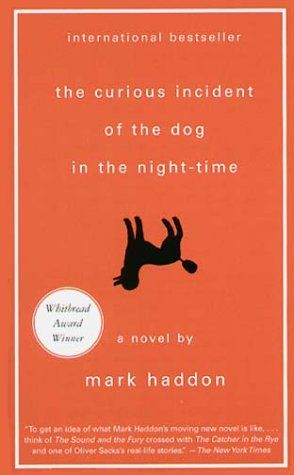
#TheList, No. 982: The Curious Incident of the Dog in the Night-time

This is a book that I am constantly seeing referenced in "top recommended books" lists, top "to read" lists, and school reading lists.  I've gather that people either really love this book or love saying that they love this book.

Okay, so what is this book about? Christopher a boy with an unnamed cognitive disorder, is writing a book that details his adventures and includes how he stumbled onto a mystery: who killed his neighbor's dog?  Sidenote, we find out this dog was murdered on page one, so I'm not spoiling anything when I say that this is another piece of evidence to my theory that if there's a dog on the cover, it's going to die.  Anyway, Christopher decides he's going to solve this mystery, but in the process, ends up uncovering unflattering truths about his own family.  The remainder of "his" book shows how he handled this information, along with how he lives each day and approaches various tasks that we readers probably don't think about. 

Now that I've finally read The Curious Incident, I can see its appeal.  In a time when research is focusing more and more on behavioral disorders and understanding people who have them, I think it's incredibly important to see these characters in children's and young adult media.  However, it's often difficult to fully capture them without giving them that Hollywood spin.  In  Francisco Stork's novel Marcelo in the Real World, the main character also has an unnamed cognitive disorder who dislikes when things are wrong and/or unethical, and by the book's end, realizes that he has the strength to make it in the real world.  I really loved that novel, but it irked me how Marcelo seemed to be characterized as almost Christlike in his ways.  But it's been awhile since I read it, so maybe I'm remembering it wrong.  Regardless, in The Curious Incident, Christopher exhibits similar truth telling and hatred of untrustworthy people, however, he's also written with consistent flaws, which makes me like it all the more.

The thing I liked best about this book is the fact that Christopher's disorder is never named.  A lot of readers assume that it is Asperger's, but it doesn't matter what disorder he has; it's the story he's telling us. If you knew the disorder, would you read the story differently?  Perhaps.  That's why it's best to just read his story and accept that he's being honest about his behavior, rather than second guessing his explanations and attributing his behavior to specific symptoms.   

Who would I recommend this to?  A young adult looking for contemporary, realistic fiction or an unconventional narrator.  Even though the novel has some dark humor in there, I wouldn't give this to someone who's looking for a comedy, unless they were a fan of dramedies.  But it's definitely the type of book that makes you think, so if you're looking for light reading, maybe pick this one up at a later date.